[ 01 ]
Public
- Services
- Ministries
- Sermons
- Events
- Prayer & care
Case study
From scattered communication to one digital centre.
Church digital platform · Strategy · UX · Full-stack development
Visit live site ↗Emmasdale SDA needed more than a new website. Information, member communication, and administration were spread across WhatsApp, Facebook, paper, and the church office.
Delivered
Platform
[ 01 ]
[ 02 ]
[ 03 ]
Context
Information was everywhere — but there was no digital centre.
Channels in play
Create one mobile-friendly platform connecting visitors, members, and leaders.
Shift
Before
After
Outcomes
Before
Quarterly reports depended on paper and office visits.
After
Department leaders can submit reports from their phones.
Before
Prayer requests lived in private messages.
After
Appropriate requests can be shared through a prayer wall while sensitive care remains confidential.
Before
Weekly information was scattered across PDFs, WhatsApp, and announcements.
After
One digital bulletin gives members a consistent place to return to.
Method
The interesting part wasn't building the website — it was figuring out what needed to be built.
[ 01 ]
Investigate
Stakeholders · channels · workflows · journeys
[ 02 ]
Diagnose
Where information, participation, and admin broke down
[ 03 ]
Architect
Public + members + leaders on one platform
[ 04 ]
Build
Website · workflows · dashboard
[ 05 ]
Ship
Live platform at emmasdalesda.org
“For the first time we can point members and visitors to one place — this Sabbath, prayer, ministries, and how to get help — instead of five different WhatsApp groups.”
Behind the build
Full investigation — context, journeys, evidence, diagnosis, and implementation detail for readers who want the forensic version.
View full investigation ↓Business context → customer journeys → evidence → diagnosis → recommendations → architecture → implementation
The business case
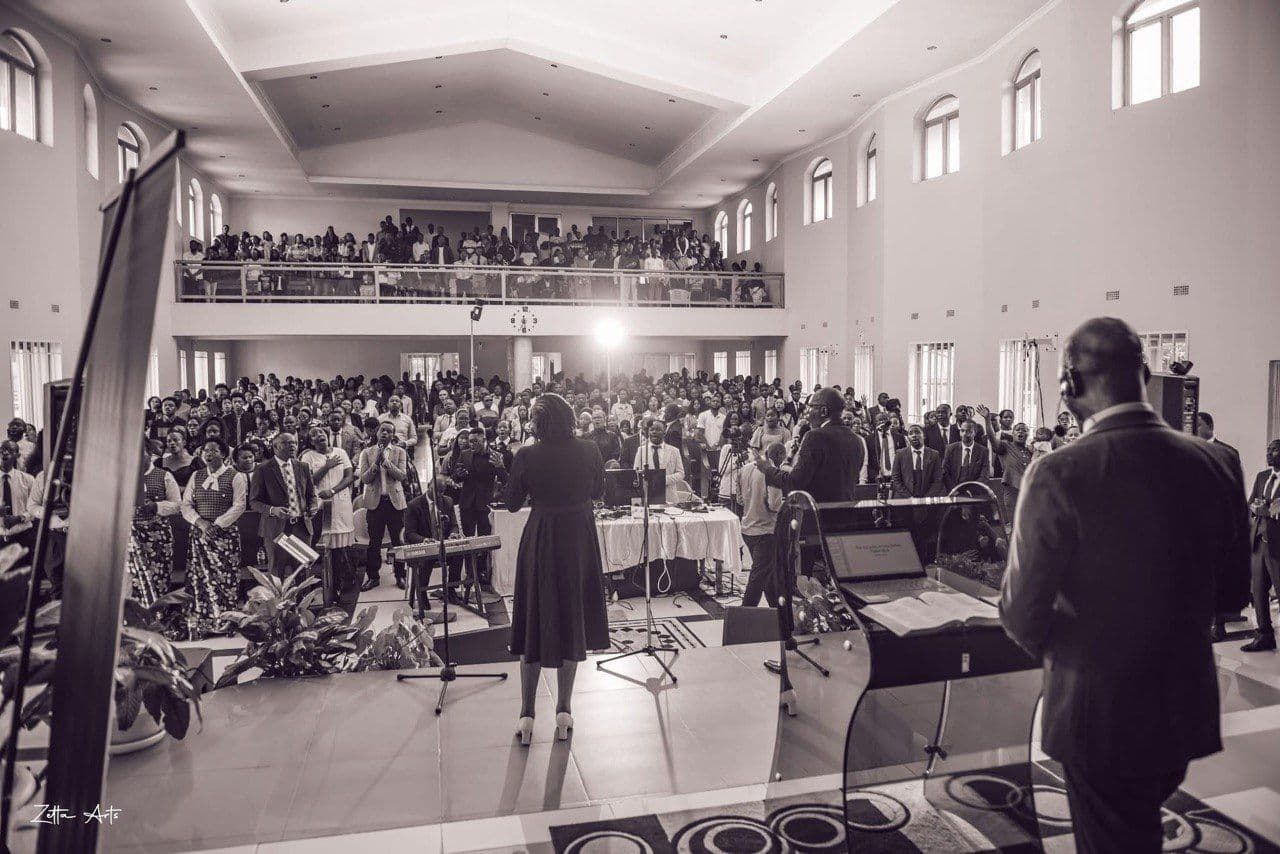
Emmasdale SDA had an active congregation, strong communication channels, and many digital touchpoints — but information, member care, and administration were spread across Facebook, WhatsApp groups, paper forms, personal phones, and the church office.
The church did not only need a better website. It needed one digital centre connecting the public, members, and church leadership.
Public website
Member experiences
Leadership platform
The result
Visitors, members, and leaders connect through one system — public information, member participation, and operational workflows on a mobile-friendly platform.
Strategy · UX · Architecture · Full-stack development — investigated, designed, built, and shipped.
The business
Visitors & seekers
Public witness
Bulletin · care · prayer
Member life
Reports · forms · records
Leadership ops
The customer
“When and where is church?”
Needs
“How do I stay connected all week?”
Needs
“Can I run my department from my phone?”
Needs
The diagnostic
Discover
Strong Facebook reach
Orient
No single official source
Participate
Prayer & care fragmented
Serve
Paper + office-bound admin
Return
Church felt tied to the building
Friction
[ 01 ]
Quarterly departmental reports, sign-offs, and routine data still meant physical forms, clerk handoffs, or long WhatsApp threads — work that had to wait until someone was at the church or at a desk.
Impact priority
█████████░
[ 02 ]
Bulletin, programme, devotions, and updates lived in Sabbath-only moments, lost PDFs, or groups you might not be in — especially for travellers, the sick, diaspora, and shift workers.
Impact priority
█████████░
[ 03 ]
People texted a leader when they needed prayer; other members rarely saw appropriate public requests or could pray alongside them in a shared space.
Impact priority
███████░░░
So what needs fixing?
The recommendation
The blueprint
            EMMASDALE DIGITAL HUB
                     │
       ┌─────────────┼─────────────┐
       ↓             ↓             ↓
    PUBLIC        MEMBERS      LEADERS
       │             │             │
   Visit · Care   Bulletin ·    Reports ·
   Ministries    Prayer wall    Forms · Care
   Sermons       Devotions      Scheduler
       │             │             │
       └─────────────┼─────────────┘
                     ↓
            ONE MOBILE-FRIENDLY HOME
What changes?
| Before | After |
|---|---|
| Paper quarterly reports | Phone-friendly submissions |
| Private prayer messages | Shared prayer wall |
| Scattered WhatsApp lists | Structured digital forms |
| Sabbath-only information | Extended church between Sabbaths |
Emmasdale SDA Church operates as an active Lusaka congregation with visible ministries and a large online audience (~5,800 Facebook followers). Value is created through worship, discipleship, care, and stewardship — not product sales. Before the platform, that work ran through disconnected Facebook posts, multiple WhatsApp groups, pulpit announcements, paper forms, and officers' personal phones.
Business diagnostic aligned with the implemented product, original SRS, and operating model — stakeholder interviews, channel audit, care-path mapping, benchmark against mature SDA and church platforms, and validation against live modules on emmasdalesda.org. June 2026 business diagnostic aligned with the implemented product, original SRS, and operating model: stakeholder interviews, social and WhatsApp workflow review, care-path mapping, SDA/church benchmarks, and audit of live public routes and staff dashboard domains. Evidence confirmed the product is shaped as church digital operations — content, events, ministries, care, bulletins, forms, quarterly reports, facility scheduling, Camp Meeting, church-document requests, and role-based access — not a static brochure.
Sources
Evidence snapshot
[ 01 ]
Department and church work still meant paper forms, office visits, and WhatsApp lists — leaders could not reliably submit quarterly reports or collect data from their phone
[ 02 ]
Members who missed Sabbath, travelled, or worshipped online had no single place for bulletin, devotions, sermons, and announcements — the church felt tied to the building and the right chat group
[ 03 ]
Prayer often went to one leader's inbox; the congregation could not see appropriate public requests and pray together, while sensitive needs still lacked a confidential path
[ 04 ]
Visitors and members could not trust one official, current source for service times, programmes, and how to request help
Visual evidence
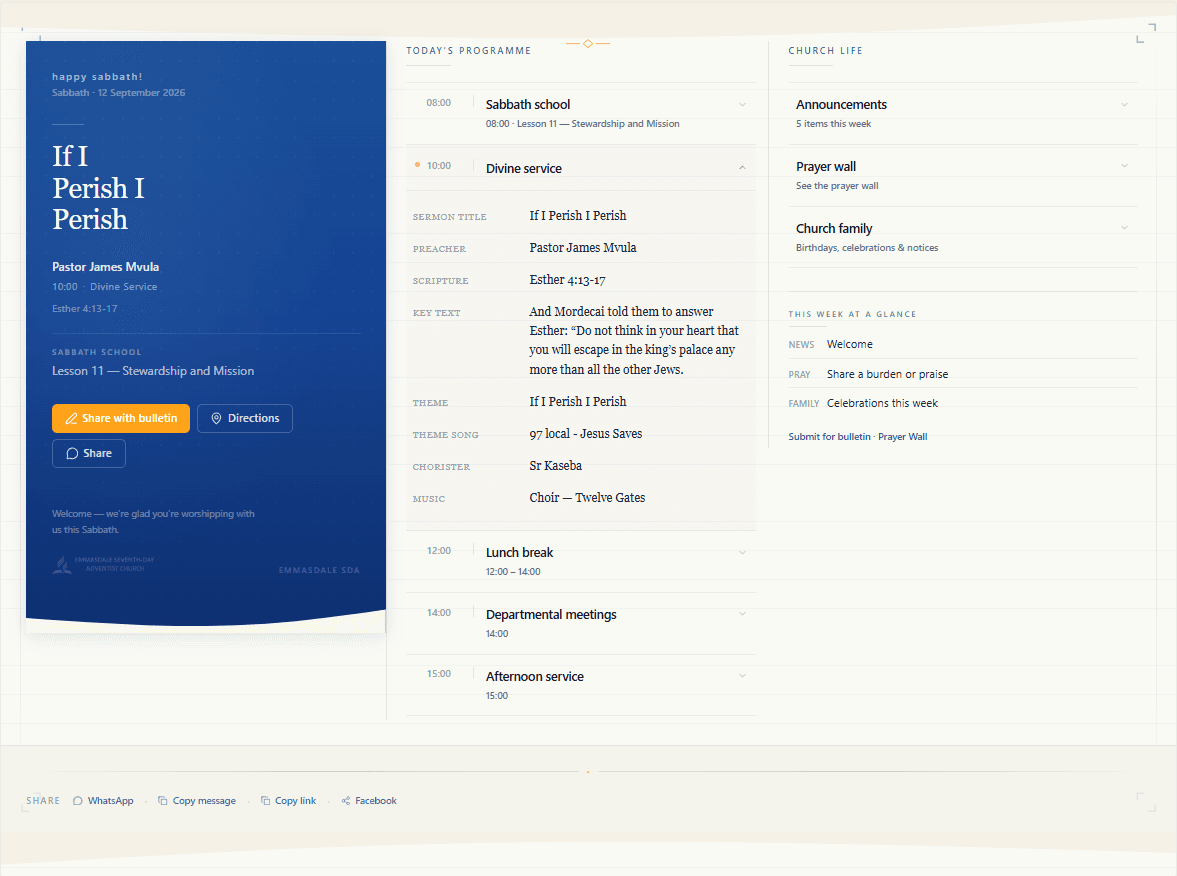
Screenshot
Digital Bulletin
The fix
01
02
03
04
05
06
03
Strategy
Make worship easy. Make administration easy.
Two connected sides, not a page collection: Side one — public witness, weekly rhythm, and participation: official service discovery, Plan Your Visit, ministries, events, sermons and articles, digital bulletin with archive, Daily with God, Sabbath School, prayer wall, care and document intake, giving guidance. Side two — leadership and administration: role-aware dashboard for bulletin publishing, content and event approval, care assignment, digital forms, quarterly departmental reports, facility scheduler, Camp Meeting and pledges, church-document issuance, and scoped ministry administration. Publishing stays controlled; confidential prayer and counselling remain staff-only.
Public layer at emmasdalesda.org: visitor and member journeys, bulletin workflow output, devotionals and Sabbath School surfaces, prayer and care forms, church-family submissions, document requests with reference tracking, and giving instructions. Staff dashboard: bulletin editor, announcements and sermons, event and ministry management, care inbox, forms and submissions, quarterly reports, facility and resource scheduler, Camp Meeting administration, church-document review and PDF issuance, user and role administration — with permissions that mirror church and ministry structure.
How it works
The platform already solves substantial parts of the original diagnosis: scattered communication, unclear Sabbath information, spiritual content without a permanent home, requests lost in informal channels, paper-dependent reporting, scheduling collisions, and manual document administration — when leaders adopt it as normal practice. The next challenge is governance and rhythm: named content owners, care response expectations, scheduler adoption, and honest scope boundaries (finance ledger, payment processing, and financial requisitions remain future modules — dashboard Requisitions are church-document requests).
Before → after
Weekly information
Before
PDF bulletins, WhatsApp posters, and pulpit repeats — easy to contradict or lose.
After
One bulletin link with Sabbath School, divine service, announcements, prayer, and archive.
Prayer & pastoral care
Before
Requests scattered across leaders' personal messages.
After
Public, anonymous, or confidential modes with leadership queues and follow-up.
Institutional memory
Before
Records in clerks' files, private chats, and officers' phones.
After
Bulletins, submissions, approvals, reports, and care queues retained in the platform.
Note
Dashboard “Requisitions” manages official church-document requests — not financial expense approval. Giving pages stay informational until treasury workflows are confirmed.
Scope & limits
Implemented: public site, digital bulletin, Daily with God, Sabbath School surfaces, prayer and care intake, digital forms, quarterly reports, facility scheduler, Camp Meeting and pledges, church-document requests, role-based dashboard. Future scope: full treasury ledger, payment processing, financial requisition chains, membership register, automated WhatsApp broadcasting, broad attendance analytics. Adoption and content ownership remain ongoing.
“For the first time we can point members and visitors to one place — this Sabbath, prayer, ministries, and how to get help — instead of five different WhatsApp groups.”
Capability
Strategy · UX · Full-stack development
If your organisation still runs on posters and personal inboxes, the friction is structural — a platform can unify public clarity and leadership workflow without replacing human judgment.
Your website might not be the problem. The customer journey might be.